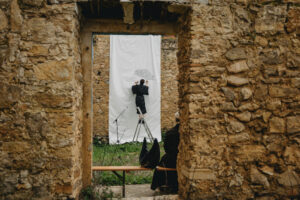
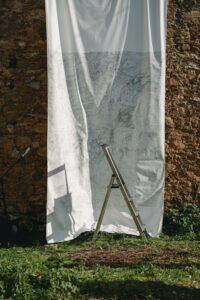
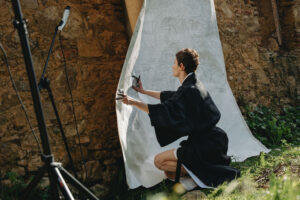
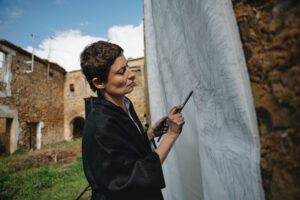
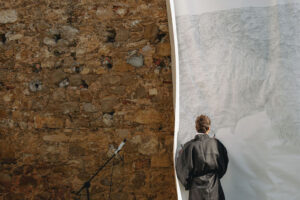
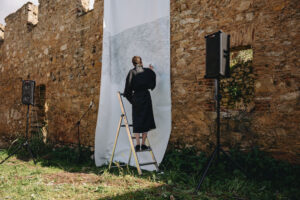
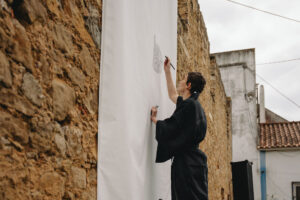
Viewing trauma as both an individual and collective reaction and consequence, the artist has created a new, process-oriented project that reflects the potential for healing and rehabilitation. Maria Proshkovska works with time, materiality and memory, inviting the viewer to reflect on the (im)possibility of returning to a ‘blank slate’. She fills the canvas centimetre by centimetre with a graphite pencil – and gives viewers the choice of whether to leave this mark on the paper or only in their memory. This repetitive cycle of creation and destruction ceases to be a single gesture and becomes an exhausting physical practice of existence, caught in the tension between memory and its erasure.
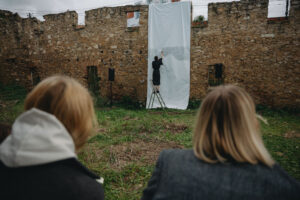
The historical context of the location forms a distinct layer within this performance. The ruins of the monastery on the slopes of Varatojo near Torres Vedras (Portugal) have, at various periods in their history, served not only as a place of prayer and seclusion, but also as a refuge – a space of protection for those in need of shelter and support. For centuries, the events and decisions of people here shaped an environment where vulnerability was not concealed but accepted as part of the human experience. Today, having lost its original function, this space retains its memory. Moreover, through artistic reinterpretation, it takes on new meaning, transforming into a site of contemporary ritual.
Performance brings this legacy to life: the act of monotonous creation and erasure becomes a secular form of collective prayer, a gesture of attentiveness to pain and to hope, which is never entirely lost. The sonnet carved into the wall of the Ermida de Santa Margarida chapel, describing the transformation of cold stone into living flesh through an unquenchable inner fire, serves as a conceptual parallel to the performance: transformation here is conceived not as destruction, but as a process in which a trace does not vanish, but transitions into another state.
A key element of this performance was both the invitation extended to the Ukrainian community in Portugal – who have found themselves here in search of refuge, bringing with them the experience of forced displacement, severed ties and rebuilding their lives from the ashes in a new place – and the involvement of the local community, for whom this space is part of the everyday landscape of memory. They all became not only spectators but also co-authors of the performance as bearers of memory – living archives, for whom erasure and return, forgetting and remembering are part of daily existence.
Through its interaction with a community united by new experiences of the present moment, the space of the former monastery once again fulfils its historical function. For the Ukrainian artist, working with the local context becomes a means of engaging in a delicate dialogue between different experiences of trauma and survival. Through memory – both personal and collective – this performance restores hope for recovery as a shared, ongoing and open process, in which the past does not disappear but is transformed.
Each subsequent performance of this kind in a new location will add a new recorded sound, and in this way the audio work will become a multi-layered testimony to an endless process. The first sound recording, made amidst the ruins of a Portuguese monastery on the slopes of Varatojo, will form the basis of a new long-term project in the artist’s practice, whilst the location itself will become a full-fledged co-author of the artwork.
This project marks the start of a new series of performances exploring the potential for post-traumatic growth and rehabilitation within the artist’s practice.